PMB 65/105 in Asphalt Specifications
We are a PMB 65/105 supplier serving procurement teams, contractors, asphalt producers, and importers in Dubai, across the UAE, and in export markets. PMB 65/105 identifies Polymer Modified Bitumen by its nominal penetration range, placing it in the middle-to-soft part of the approved PMB line. The applicable standard and project requirements define the binder’s other properties.
Each enquiry is quoted against the buyer’s specification, and we confirm actual availability at the quotation stage. For background on polymer modified bitumen and the approved ranges, visit our Polymer Modified Bitumen category page.
What Does PMB 65/105 Mean?
PMB stands for Polymer Modified Bitumen. The figures 65/105 describe its nominal penetration range: at 25 °C, the needle penetration falls within 65 to 105 tenths of a millimeter when tested against the applicable method. This range helps buyers understand consistency, but it does not describe every property of the binder.
| The 65/105 range tells you | The 65/105 range does not tell you |
| The binder’s consistency band at 25 °C | Its softening point or softening-point class |
| That it is softer by penetration than ranges such as 25/55 | Its elastic recovery or cohesion |
| That the binder is polymer modified | The polymer type or formulation |
| Where it overlaps with neighbouring penetration ranges | Whether it suits a particular climate, traffic level or pavement layer |
The project specification defines the additional properties. Buyers should confirm them in the product’s Technical Data Sheet (TDS) and relevant test results.
PMB 65/105 Characteristics
By penetration, PMB 65/105 is softer than harder modified grades. A softer consistency may support flexibility at lower service temperatures. However, actual behaviour depends on the formulation and the properties demonstrated by the required tests.
Polymer modification distinguishes this binder from an unmodified product with similar penetration. Depending on the formulation, modification may increase cohesion, improve elastic recovery, and reduce temperature sensitivity. In a suitable asphalt mix, these properties may help address deformation and cracking. Nevertheless, the 65/105 designation alone does not guarantee these outcomes.
For UAE and wider Gulf projects, buyers should pay close attention to the softening-point requirement and mix design. High summer pavement temperatures can place substantial demands on deformation resistance. Therefore, the project specification—not the penetration range alone—must determine whether PMB 65/105 is suitable.
PMB 65/105 Applications
PMB 65/105 may be considered for the following road-paving and asphalt applications when the project specification accepts this range. In each case, suitability depends on climate, traffic, pavement design, and the required binder properties.
- Climate-led applications: Paving in regions or seasons with wide temperature variations, where the specification balances lower-temperature flexibility with deformation resistance in heat.
- Layer-led applications: Surface layers and thinner asphalt courses where the pavement design calls for a modified binder of moderate-to-soft consistency.
- Traffic-led applications: Roads with moderate traffic loading, plus maintenance or rehabilitation projects where the specification permits this range.
- Specification-led applications: Infrastructure and authority projects that list PMB 65/105 among their accepted binders.
Designers may specify harder ranges for heavily loaded roads or very hot sites. However, this remains a project-specific decision rather than a universal rule.
PMB 65/105 and EN 14023
For procurement and technical teams, the key point is that EN 14023 classifies Polymer Modified bitumen using more than one property class. The framework covers penetration ranges, softening-point classes and additional properties. Each project specification selects the combination it requires.
Therefore, 65/105 identifies the penetration part of the classification. A complete designation also states the applicable minimum softening-point class and any other required properties. No single softening-point class automatically applies to every PMB 65/105 product.
The GCC Standardization Organization has adopted EN 14023 as a Gulf standard. However, the tender documents remain the reference for the product and properties required for a particular project. We confirm the applicable designation and PMB 65/105 specifications in the quotation and the TDS for the offered product.
A Note on PG Specifications
Performance Grade (PG) classifies binders according to design pavement temperatures. This is a separate system from EN 14023. As a result, PMB 65/105 has no automatic PG equivalent, and a PG binder may or may not contain polymer modification.
For projects written around PG requirements, see our Performance Grade (PG) bitumen range.
PMB 65/105 vs Conventional Penetration Bitumen
Conventional penetration bitumen is an unmodified binder classified mainly by penetration. You can review these grades on our Penetration Bitumen page. By contrast, PMB 65/105 contains polymer modification and is classified by penetration alongside softening point and any other specified properties.
From a procurement perspective, these are separate product requirements. A soft conventional grade cannot replace PMB 65/105 simply because its penetration figures look similar. Likewise, PMB is not automatically the right choice for a project designed around conventional bitumen. The project specification determines the acceptable binder.
PMB 65/105 vs Other PMB Ranges
Buyers encounter different PMB ranges because pavement designers match binder consistency to climate, pavement layer, and loading. A higher or lower penetration range is not inherently better; each range must meet the applicable specification.
PMB 65/105 sits at a transition point in the approved line. Its lower limit of 65 is above the upper limit of 25/55, so it shares no nominal penetration values with 10/40 or 25/55. However, it overlaps with 45/80 and 40/100 below it, and with 75/130 and 90/150 above it.
This overlap matters when comparing products. A binder declared under one range is not automatically acceptable under another, even if a measured penetration value falls within both ranges. The project must assess the complete designation, including the softening-point class and any additional requirements. Therefore, enquiries should specify PMB 65/105 explicitly.
For an overview of the approved ranges, visit our PMB category page.
Choosing PMB 65/105 for a Project
Choosing a suitable binder involves several checks. We confirm the applicable product specification with you at the quotation stage.
Before the Enquiry
Review the project specification and applicable standard. Identify the required penetration range, softening-point class, and any additional properties. Also consider the climate, service conditions, traffic loading, and pavement design.
At Enquiry
Send us the binder clause or the relevant specification extract, along with the required quantity and destination. This information helps us prepare an offer against the correct requirements.
At Quotation
Compare the offered product’s TDS with the project specification. Check its classification, test methods, and all required properties before proceeding.
Before Supply
Complete the required consultant, authority, or buyer approvals. Also agree on the test documentation that must accompany the supplied batch.
PMB 65/105 Supply from Dubai
Procurement teams contact us as a PMB 65/105 supplier in Dubai when they need a quotation based on a specific project, whether the destination is in the UAE or abroad. We handle each enquiry individually within the Dubai bitumen market.
For UAE buyers, the offer follows the binder clause in the contract documents. For international buyers, it also sets out proposed delivery terms, routing and the shipping documents required at the destination.
We confirm availability, origin and loading port in writing for each order rather than assuming these details in advance.
PMB 65/105 Documentation
Documentation depends on the product and order requirements. Buyers can organise the required documents in two stages.
With the quotation: Review the Technical Data Sheet, including the offered product’s classification and specification basis. This allows the buyer to check compliance before placing an order.
With the supply: Confirm the Certificate of Analysis for the batch, any additional tests required by the specification, and third-party inspection records where inspection forms part of the order. Buyers can also request a Safety Data Sheet.
List your documentation requirements in the enquiry so they can be confirmed in the offer.
Frequently Asked Questions
What is PMB 65/105?
A polymer modified bitumen identified by a nominal penetration range of 65 to 105 (0.1 mm at 25 °C). It sits in the middle-to-soft part of the approved PMB line, with its full specification set by the project.
What does 65/105 mean in PMB?
It is the window the binder’s penetration must fall within at 25 °C. On its own, it says nothing about softening point, elastic recovery, cohesion or formulation.
Is PMB 65/105 an EN 14023 grade?
65/105 is one of the penetration ranges used within EN 14023. The designation is only complete once the applicable minimum softening-point class is added, as the governing specification requires.
What can PMB 65/105 be used for?
Where a specification allows it, for surface layers, thinner asphalt courses, moderate-traffic roads and maintenance work, particularly where temperature variation is a design consideration.
How does PMB 65/105 differ from conventional bitumen?
It contains a polymer modifier and is classified by penetration together with softening point and other properties. A conventional grade of similar penetration is not an equivalent without the engineer’s approval.
Can a product meeting another PMB range be supplied instead?
Not automatically. Even where penetration values overlap, conformity is assessed against the complete designation the project specifies, so the offer should reference 65/105 specifically.
Can Dubai Bitumen supply PMB 65/105?
Yes. As a PMB 65/105 supplier, we quote for buyers in Dubai, the wider UAE and export markets, confirming availability, origin and loading port for each order.
What documentation can be requested for PMB 65/105?
A TDS at quotation stage, then a batch COA and any specified test or inspection documents with supply. An SDS can also be requested.
Request a Quote for PMB 65/105
The applicable specification, documentation and pricing for PMB 65/105 are confirmed according to your project requirements. To receive an offer for Dubai, elsewhere in the UAE or your export destination, send:
- the project specification or binder clause, including the required softening-point class
- destination country and port
- quantity
- packaging requirement
- documentation and inspection requirements
Request a Quote for PMB 65/105
The rates on our Dubai Bitumen Prices page cover conventional grades and are not PMB prices; PMB 65/105 is priced by quotation.


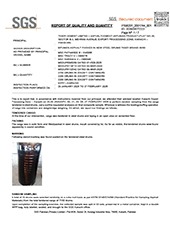
SGS Inspection Report Grade 35/50 Loading the Month of Jan-Feb 2026
Tiger Bitumen Price List
English Version
French Version